Using Icons in the Sanctuary to Teach the Faith (Part 4)
Dormition of the Theotokos The falling asleep or 'death' of the Theotokos and the subsequent assumption of her soul to heaven is illustrated on this icon. The baby hel by Christ actually represents Mary's soul. This event sets the death of the Virgin apart from all others.
Holy Orders
The setting apart of men for service to the church as deacons, priests and bishops, through the laying on of hands, prayer and annointing is called Holy Orders. Another form of service instituted by the church are the vows made by monks and nuns (bishops must be unmarried while priests may marry). While marriage is a path towards heaven while living in the world, monasticism is an individual journey towards heaven separated from the world.
Entry into Jerusalem or Flowery/Willow/Palm Sunday The entry of the Lord into Jerusalem shows the disciples following and the people of the city greeting Christ as is described in the Bible. The donkey's colt on which is rides is an 'unclean' animal and this foreshadows that both Jews and 'unclean' gentiles will both be welcome in the future Church.
Holy Anointing
Important people were honored by covering the ground before them. Palms were a symbol of victory as well as a major economic resource in Judea. These were combined in a unique way to give Christ the short-lived honor worthy of who He was. Just as the palms covered the unclean ground, the sacrament of Holy Anointing covers the recipient with oil and prayer to remove physical and spiritual sickness from them. This is practiced in the Orthodox Church on the Wednesday of Holy Week and when an individual Christian needs healing.
Ascension of Christ
The Ascension of Christ to Heaven forty days after Pascha shows the Virgin Mary, angels and apostles watching the Lord float upwards. The disciples returned to Jerusalem where they had been commanded to remain (Act 1) until they received the promised power from on high. This began ten days of intense prayer.
Jesus Prayer
St. Paul admonished believers to pray 'without ceasing'...that means with no breaks. In order to do this the Orthodox Church continues to promote the practice from the early centuries of the Church called the 'Jesus Prayer'. First repeated by monks in the desert, the simple words "Lord Jesus Christ, Son of God, have mercy on me a sinner" are full of theological depth and with continued practice can become a 'prayer of the heart' that never stops during worship, work or recreational time.
Pentecost
The most distinct feature of the Icon of Pentecost is the man shown below the Twelve Apostles (St. Paul being included). He is often called 'cosmos' and represents lost humanity trapped in a cave of spiritual darkness. He is crowned as the greatest of God's creation and holds twelve scrolls representing the teachings of Christ conveyed to the world through the apostles. The rays that radiate from him represent the sanctifying work of the Holy Spirit, descending at the top of the icon, within each Christian.
The Church
Pentecost is the 'birthday of the Church'. Baptism makes one a part of the church, the Body of Christ, but John 6 reminds us that only those who eat the body and blood of Christ are truly living members of the Church. The Church is not limited to earth, the fighting or 'militant' church, but also those members who have fallen asleep and are part of the Church Triumphant awaiting the resurrection.
Exaltation of the Cross
This feast marks the finding of the True Cross of Christ by the Empress Helena in AD 326. Three buried crosses were found but only that on which Christ died healed a sick woman (other accounts say raised someone to life). The cross, that mark of shame in the early Roman world, became the symbol of Triumph for Christians and eventually the Roman Empire itself under Emperor Constantine.
Sign of the Cross
Crosses appear in icons, behind the head of Christ in halos, on our churches, on Bible and prayer books and on ourselves (*demonstrate the Sign of the Cross). Two fingers joined represent the human and divine natures of Christ while three others represent the Trinity. Orthodox use the right hand and move from right to left just as the early church practiced. A distinct feature of Orthodox crosses is the three bars: the top representing the plackard Pilate had placed above Christ's head and the lower angled cross representing where His feet rested (pointing upwards on the right to symbolize the good thief).
Pascha
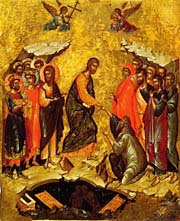
Pascha (meaning Passover) is Orthodox 'Easter'. It is the premier feast of the Church and is above all others. The Lord's stands on the gates of Hades in the icon, reaching out to Adam and Eve. On the right, St. John the Baptist is joined by Kings David and Solomon all of whom shared in prophesying His coming. The keys and broken locks of hell and death float in the darkness.
Prayer for the Dead
The earliest catacombs contain requests for prayer for the departed. Those that have fallen asleep are commemorated in the Liturgy and in special prayer services. Individual Orthodox Christians offer prayer for their departed loved ones. The Church teaches that the final destination of souls is not fixed at the particular judgement following death but can be inflluenced by the prayers of the Church on earth. Recorded visions of saints being thanked for their intercession which removed their soul from the fires punishment are numerous. Whether a soul will join the sheep or goats, saved or damned, will be decided at the Last Judgement of Christ when the resurrected bodies will join the soul in its final state.
Next....
Making the Church Tour Effective
Dormition of the Theotokos The falling asleep or 'death' of the Theotokos and the subsequent assumption of her soul to heaven is illustrated on this icon. The baby hel by Christ actually represents Mary's soul. This event sets the death of the Virgin apart from all others.
Holy Orders
The setting apart of men for service to the church as deacons, priests and bishops, through the laying on of hands, prayer and annointing is called Holy Orders. Another form of service instituted by the church are the vows made by monks and nuns (bishops must be unmarried while priests may marry). While marriage is a path towards heaven while living in the world, monasticism is an individual journey towards heaven separated from the world.
Entry into Jerusalem or Flowery/Willow/Palm Sunday The entry of the Lord into Jerusalem shows the disciples following and the people of the city greeting Christ as is described in the Bible. The donkey's colt on which is rides is an 'unclean' animal and this foreshadows that both Jews and 'unclean' gentiles will both be welcome in the future Church.
Holy Anointing
Important people were honored by covering the ground before them. Palms were a symbol of victory as well as a major economic resource in Judea. These were combined in a unique way to give Christ the short-lived honor worthy of who He was. Just as the palms covered the unclean ground, the sacrament of Holy Anointing covers the recipient with oil and prayer to remove physical and spiritual sickness from them. This is practiced in the Orthodox Church on the Wednesday of Holy Week and when an individual Christian needs healing.
Ascension of Christ
The Ascension of Christ to Heaven forty days after Pascha shows the Virgin Mary, angels and apostles watching the Lord float upwards. The disciples returned to Jerusalem where they had been commanded to remain (Act 1) until they received the promised power from on high. This began ten days of intense prayer.
Jesus Prayer
St. Paul admonished believers to pray 'without ceasing'...that means with no breaks. In order to do this the Orthodox Church continues to promote the practice from the early centuries of the Church called the 'Jesus Prayer'. First repeated by monks in the desert, the simple words "Lord Jesus Christ, Son of God, have mercy on me a sinner" are full of theological depth and with continued practice can become a 'prayer of the heart' that never stops during worship, work or recreational time.
Pentecost
The most distinct feature of the Icon of Pentecost is the man shown below the Twelve Apostles (St. Paul being included). He is often called 'cosmos' and represents lost humanity trapped in a cave of spiritual darkness. He is crowned as the greatest of God's creation and holds twelve scrolls representing the teachings of Christ conveyed to the world through the apostles. The rays that radiate from him represent the sanctifying work of the Holy Spirit, descending at the top of the icon, within each Christian.
The Church
Pentecost is the 'birthday of the Church'. Baptism makes one a part of the church, the Body of Christ, but John 6 reminds us that only those who eat the body and blood of Christ are truly living members of the Church. The Church is not limited to earth, the fighting or 'militant' church, but also those members who have fallen asleep and are part of the Church Triumphant awaiting the resurrection.
Exaltation of the Cross
This feast marks the finding of the True Cross of Christ by the Empress Helena in AD 326. Three buried crosses were found but only that on which Christ died healed a sick woman (other accounts say raised someone to life). The cross, that mark of shame in the early Roman world, became the symbol of Triumph for Christians and eventually the Roman Empire itself under Emperor Constantine.
Sign of the Cross
Crosses appear in icons, behind the head of Christ in halos, on our churches, on Bible and prayer books and on ourselves (*demonstrate the Sign of the Cross). Two fingers joined represent the human and divine natures of Christ while three others represent the Trinity. Orthodox use the right hand and move from right to left just as the early church practiced. A distinct feature of Orthodox crosses is the three bars: the top representing the plackard Pilate had placed above Christ's head and the lower angled cross representing where His feet rested (pointing upwards on the right to symbolize the good thief).
Pascha
Pascha (meaning Passover) is Orthodox 'Easter'. It is the premier feast of the Church and is above all others. The Lord's stands on the gates of Hades in the icon, reaching out to Adam and Eve. On the right, St. John the Baptist is joined by Kings David and Solomon all of whom shared in prophesying His coming. The keys and broken locks of hell and death float in the darkness.
Prayer for the Dead
The earliest catacombs contain requests for prayer for the departed. Those that have fallen asleep are commemorated in the Liturgy and in special prayer services. Individual Orthodox Christians offer prayer for their departed loved ones. The Church teaches that the final destination of souls is not fixed at the particular judgement following death but can be inflluenced by the prayers of the Church on earth. Recorded visions of saints being thanked for their intercession which removed their soul from the fires punishment are numerous. Whether a soul will join the sheep or goats, saved or damned, will be decided at the Last Judgement of Christ when the resurrected bodies will join the soul in its final state.
Next....
Making the Church Tour Effective