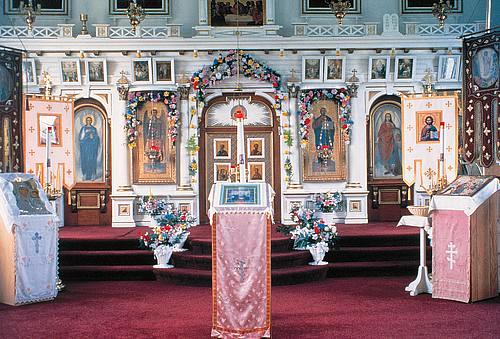
Using Icons on the Iconostasis to Teach the Faith (Part 1)
Explaining the icons found in every Orthodox church can also be used as a guide to teach the basics of the Faith. For a church tour, it is important to not explain everything: give just enough information to the visitor so that he/she learns something but not so complete that no questions about Orthodoxy remain. This gives incentive to come to the inquirer classes to learn more. Three teaching options are given: the icon itself, an applicable Orthodox teaching, and an icon characteristic.
Iconostasis
The iconostasis separates the sanctuary from the central area (nave) just like the curtain set apart the Holy of Holies in the Jewish tabernacle. The tabernacle was a shadow of the Christian church's sanctuary which in turn is a shadow of the heavenly sanctuary (Hebrews 9).
Teaching
The imperfect sacrifice of animals forshadowed Christ's perfect sacrifice of Himself for sin. The yearly sacrifice of blood sprinkled on the mercy seat behind the curtain in the Holy of Hoiies was made once a year. The Orthodox priest consecrates the bread and wine into the real body and blood of Christ supernaturally behind the iconostasis at each Divine Liturgy.
Iconography
In icons blue usually represents the heavenly or spiritual while red represents the earthly and human. Compare the clothing of Christ and the Theotokos: Christ was first God and became man so He is shown with a blue outer garment over red. The colors on the Theotokos are opposite: Mary was first human and received grace to assume her spiritual strength, so, red is outside while blue in underneath.
Royal Doors: the Annunciation
The angel Gabriel is shown greeting the Virgin Mary to announce she has been chosen to bear the Son of God.
Teaching
Just as Christ entered the world as a human by 'taking flesh' from the Theotokos (which means 'God-bearer') we enter the spiritual world by 'taking' the real body and blood of Christ which are consecrated on the Holy Table. Mary became the 'door' for Christ to enter our world when she accepted God's plan for her so it is appropriate that the doors through which the priest enters to bring us our spiritual food have this scene depicted (Luke 1).
Iconography
Angels are usually shown with wings (although the Bible only mentions wings on the higher ranks such as cherubim and seraphim) and are dressed in royal Byzantine-era attire. The draped, partial building over the Virgin is used in iconography to show that the scene takes place indoors.
Christ
The icon of Christ shown giving the traditional blessing using the fingers to spell "IX XC" which are the first initials in Greek for Jesus Christ. Because the Theotokos presents the church, the 'sheep' of Christ, she is always positioned on the right side of Christ on the iconostasis (which is our 'left'). (Matthew 25)
Teaching
God the Father cannot be seen as His Glory is too great. The Holy Spirit as a spirit is also invisible. Christ in His human nature, in human flesh, is our only way to see God with our earthly eyes.
Iconography
Christ is depicted in various stages of his earthly life in icons: as an adult on the iconostasis, as an unborn chilld in the Theotokos (Mary on the icon above the sanctuary with Christ in a circle or triangle representing the womb), as a young man (in the sanctuary with no beard), and as Pantocrator or 'Lord of All' looking down on use from heaven (on the parish ceiling).
Theotokos
The Virgin Mary is almost always depicted with Christ because her spiritual power of intercession as well as her grace derives from her relationship with her Son (she is not a 'god'). Most icons of the Theotokos look similar because they are based on the original icons painted by the Evangelist St. Luke and reflect how she really looked just as icons of saints reflect their true apperance. Images of Christ are based on imprints miraculously made on cloths by Christ Himself and recorded in Church Tradition.
Teaching
The Orthodox Church attaches great importance to the Seven Ecumenical (universal) Councils held in the first eight centuries of the Church. One of those clearly defined that Mary was the Theotokos, the 'mother of God' because she was the actual mother of His human nature but the Divine nature was also present. The final council of the Church, before the Roman Catholics separated in the 11th century, clearly declared that the veneration of icons was correct and had always been the practice of the Church.
Iconography
Most icons have Greek or Slavonic letters that describe what is represented. Above Mary are the Greek letters that resemble 'MP OY'. These are the first two letters of Mary and Theotokos (Mother of God). The line above the letters shows that they are the first two letters of a longer name or term.
Next....
Using Icons on the Iconostasis to Teach the Faith Part 2
Explaining the icons found in every Orthodox church can also be used as a guide to teach the basics of the Faith. For a church tour, it is important to not explain everything: give just enough information to the visitor so that he/she learns something but not so complete that no questions about Orthodoxy remain. This gives incentive to come to the inquirer classes to learn more. Three teaching options are given: the icon itself, an applicable Orthodox teaching, and an icon characteristic.
Iconostasis
The iconostasis separates the sanctuary from the central area (nave) just like the curtain set apart the Holy of Holies in the Jewish tabernacle. The tabernacle was a shadow of the Christian church's sanctuary which in turn is a shadow of the heavenly sanctuary (Hebrews 9).
Teaching
The imperfect sacrifice of animals forshadowed Christ's perfect sacrifice of Himself for sin. The yearly sacrifice of blood sprinkled on the mercy seat behind the curtain in the Holy of Hoiies was made once a year. The Orthodox priest consecrates the bread and wine into the real body and blood of Christ supernaturally behind the iconostasis at each Divine Liturgy.
Iconography
In icons blue usually represents the heavenly or spiritual while red represents the earthly and human. Compare the clothing of Christ and the Theotokos: Christ was first God and became man so He is shown with a blue outer garment over red. The colors on the Theotokos are opposite: Mary was first human and received grace to assume her spiritual strength, so, red is outside while blue in underneath.
Royal Doors: the Annunciation
The angel Gabriel is shown greeting the Virgin Mary to announce she has been chosen to bear the Son of God.
Teaching
Just as Christ entered the world as a human by 'taking flesh' from the Theotokos (which means 'God-bearer') we enter the spiritual world by 'taking' the real body and blood of Christ which are consecrated on the Holy Table. Mary became the 'door' for Christ to enter our world when she accepted God's plan for her so it is appropriate that the doors through which the priest enters to bring us our spiritual food have this scene depicted (Luke 1).
Iconography
Angels are usually shown with wings (although the Bible only mentions wings on the higher ranks such as cherubim and seraphim) and are dressed in royal Byzantine-era attire. The draped, partial building over the Virgin is used in iconography to show that the scene takes place indoors.
Christ
The icon of Christ shown giving the traditional blessing using the fingers to spell "IX XC" which are the first initials in Greek for Jesus Christ. Because the Theotokos presents the church, the 'sheep' of Christ, she is always positioned on the right side of Christ on the iconostasis (which is our 'left'). (Matthew 25)
Teaching
God the Father cannot be seen as His Glory is too great. The Holy Spirit as a spirit is also invisible. Christ in His human nature, in human flesh, is our only way to see God with our earthly eyes.
Iconography
Christ is depicted in various stages of his earthly life in icons: as an adult on the iconostasis, as an unborn chilld in the Theotokos (Mary on the icon above the sanctuary with Christ in a circle or triangle representing the womb), as a young man (in the sanctuary with no beard), and as Pantocrator or 'Lord of All' looking down on use from heaven (on the parish ceiling).
Theotokos
The Virgin Mary is almost always depicted with Christ because her spiritual power of intercession as well as her grace derives from her relationship with her Son (she is not a 'god'). Most icons of the Theotokos look similar because they are based on the original icons painted by the Evangelist St. Luke and reflect how she really looked just as icons of saints reflect their true apperance. Images of Christ are based on imprints miraculously made on cloths by Christ Himself and recorded in Church Tradition.
Teaching
The Orthodox Church attaches great importance to the Seven Ecumenical (universal) Councils held in the first eight centuries of the Church. One of those clearly defined that Mary was the Theotokos, the 'mother of God' because she was the actual mother of His human nature but the Divine nature was also present. The final council of the Church, before the Roman Catholics separated in the 11th century, clearly declared that the veneration of icons was correct and had always been the practice of the Church.
Iconography
Most icons have Greek or Slavonic letters that describe what is represented. Above Mary are the Greek letters that resemble 'MP OY'. These are the first two letters of Mary and Theotokos (Mother of God). The line above the letters shows that they are the first two letters of a longer name or term.
Next....
Using Icons on the Iconostasis to Teach the Faith Part 2