Using Feast Day Icons in the Sanctuary to Teach the Faith (Part 3)
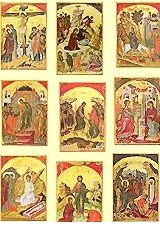
This page will use a less detailed approach to additional icons found in most Orthodox churches. The 'heavy' information given in the first two parts needs a 'break' so this is faster paced. Always customize your church's tour by doing some research on any unique icons that are present. The icons of Major Feasts are used to present the Mysteries and other key facets of Orthdoxy.
Annunciation
The Virgin Mary is greeted and told by the Archangel Gabriel, God's official messenger, that she has been chosen to bring the Messiah into the world. She accepts.
Salvation
The Orthodox Church, God's official messenger in the modern world, tells the world about the salvation found in Christ but just like Mary, each person has a choice to accept or reject God's offer.
Nativity of the Theotokos
The Theotokos' birth is celebrated on September 8, a few days after the official start of the Church Year. The icon shows St. Anne, the mother of Mary along with other scenes that took place before and after Mary's birth (since icons are beyond time and space, the past, present and future merge).
Baptism
The sacrament of baptism is how we are born again into the the body of Christ. Without the Virgin Mary we would not have had Christ the Savior. Without the spiritual rebirth of baptism we would be unable to receive God's grace for salvation.
Nativity of Christ/Christmas
Christ was born in Bethlehem in a cave which appears behind the Theotokos in the icon. Again we have events shown together that took place at different times: the angels and shepherds, the wise men and Joseph being tempted by the devil to doubt Mary's virtue.
Chrismation
In ancient times the midwife would wash the newborn infant after birth and olive oil was used to lubricate the baby's skin. After baptism, new Christians are anointed with Holy Oil, receiving the Holy Spirit that is an internal, spiritual seal.
Presentation of Jesus at the Temple
The aged Simeon holds the Christ child who was brought to the temple after 40 days by Mary and Joseph. In most icons over Mary and Jesus is a kivorion or 'canopy' that was often built in early times over the place when there Holy Table stood, covering the area of the consecration of the bread and wine. The icon forshadows Christ who will become the Bread of Life.
Eucharist
Baptism, christmation and communion are administered at one time in the Orthodox Church. Christ said we must eat His Body and drink His blood we have "no life" in us (John 6) so we begin feeding infants this spiritual food to give them a head start in the spiritual struggles ahead.
Baptism of Christ/Theophany
Christ is baptized (immersed in water as a visible sign of repentance) by his cousin John the Baptist. This is a clear manifestion of the Trinity: the voice of the Father is heard and the Holy Spirit descends like a dove on the newly baptized Son.
Trinity
The doctrine of the Trinity makes Christianity unique among all religions of the world. There is one God in essence but three distinct and equal persons in God: the Father, the Son and the Holy Spirit. Christianity is not polytheistic because there is only one God even though there are three persons. Christianity is not monotheistic in the same way as Jews and Moslems because their god is only 'one person'.
Presentation of the Theotokos
Church tradition tells us that the Virgin Mary was taken around three years of age to serve in the Jewish Temple with other young girls as a result of the vow by her parents, Saints Joachim and Anne. Mary had new clothes put on her before entering the Temple and is shown greeted by St. Zecharias, the future father of John the Baptist.
Trinity
Just as the Virgin Mary was dressed in fresh, new clothes to enter the Temple, Christians spiritually remove the old clothes of sin through the Mystery of Confession. This can restore the soul to the purity it had at baptism and prepares the person to worthily receive Holy Communion.
Transfiguration
Christ is shown in a mandorla (almond shaped dark area) that shows that His transformation by the noetic or heavenly light is beyond time and space. Moses (holding the Law) and Elijah represent the Old Testament Law and prophets which were both witnesses to the coming Messiah.
Marriage
There are two paths to salvation ordained by God: the first is marriage. Just as Adam and Eve shared a life together in the beginning, a husband and wife are able to sanctify themselves and their children through the sacrament of Holy Matrimony.
Next....
Using Feast Day Icons to Teach and Evangelize Part 4
This page will use a less detailed approach to additional icons found in most Orthodox churches. The 'heavy' information given in the first two parts needs a 'break' so this is faster paced. Always customize your church's tour by doing some research on any unique icons that are present. The icons of Major Feasts are used to present the Mysteries and other key facets of Orthdoxy.
Annunciation
The Virgin Mary is greeted and told by the Archangel Gabriel, God's official messenger, that she has been chosen to bring the Messiah into the world. She accepts.
Salvation
The Orthodox Church, God's official messenger in the modern world, tells the world about the salvation found in Christ but just like Mary, each person has a choice to accept or reject God's offer.
Nativity of the Theotokos
The Theotokos' birth is celebrated on September 8, a few days after the official start of the Church Year. The icon shows St. Anne, the mother of Mary along with other scenes that took place before and after Mary's birth (since icons are beyond time and space, the past, present and future merge).
Baptism
The sacrament of baptism is how we are born again into the the body of Christ. Without the Virgin Mary we would not have had Christ the Savior. Without the spiritual rebirth of baptism we would be unable to receive God's grace for salvation.
Nativity of Christ/Christmas
Christ was born in Bethlehem in a cave which appears behind the Theotokos in the icon. Again we have events shown together that took place at different times: the angels and shepherds, the wise men and Joseph being tempted by the devil to doubt Mary's virtue.
Chrismation
In ancient times the midwife would wash the newborn infant after birth and olive oil was used to lubricate the baby's skin. After baptism, new Christians are anointed with Holy Oil, receiving the Holy Spirit that is an internal, spiritual seal.
Presentation of Jesus at the Temple
The aged Simeon holds the Christ child who was brought to the temple after 40 days by Mary and Joseph. In most icons over Mary and Jesus is a kivorion or 'canopy' that was often built in early times over the place when there Holy Table stood, covering the area of the consecration of the bread and wine. The icon forshadows Christ who will become the Bread of Life.
Eucharist
Baptism, christmation and communion are administered at one time in the Orthodox Church. Christ said we must eat His Body and drink His blood we have "no life" in us (John 6) so we begin feeding infants this spiritual food to give them a head start in the spiritual struggles ahead.
Baptism of Christ/Theophany
Christ is baptized (immersed in water as a visible sign of repentance) by his cousin John the Baptist. This is a clear manifestion of the Trinity: the voice of the Father is heard and the Holy Spirit descends like a dove on the newly baptized Son.
Trinity
The doctrine of the Trinity makes Christianity unique among all religions of the world. There is one God in essence but three distinct and equal persons in God: the Father, the Son and the Holy Spirit. Christianity is not polytheistic because there is only one God even though there are three persons. Christianity is not monotheistic in the same way as Jews and Moslems because their god is only 'one person'.
Presentation of the Theotokos
Church tradition tells us that the Virgin Mary was taken around three years of age to serve in the Jewish Temple with other young girls as a result of the vow by her parents, Saints Joachim and Anne. Mary had new clothes put on her before entering the Temple and is shown greeted by St. Zecharias, the future father of John the Baptist.
Trinity
Just as the Virgin Mary was dressed in fresh, new clothes to enter the Temple, Christians spiritually remove the old clothes of sin through the Mystery of Confession. This can restore the soul to the purity it had at baptism and prepares the person to worthily receive Holy Communion.
Transfiguration
Christ is shown in a mandorla (almond shaped dark area) that shows that His transformation by the noetic or heavenly light is beyond time and space. Moses (holding the Law) and Elijah represent the Old Testament Law and prophets which were both witnesses to the coming Messiah.
Marriage
There are two paths to salvation ordained by God: the first is marriage. Just as Adam and Eve shared a life together in the beginning, a husband and wife are able to sanctify themselves and their children through the sacrament of Holy Matrimony.
Next....
Using Feast Day Icons to Teach and Evangelize Part 4